Thursday, January 31, 2013

Buckhorn: Mayor Foster Doing Just What He Should Be Doing

Sitting down together for a rare joint interview, Tampa Mayor Bob Buckhorn and St. Petersburg Bill Foster spoke about where they saw the Tampa Bay Rays' Stadium Saga heading.

To watch the interview, visit this link on WTSP.com.
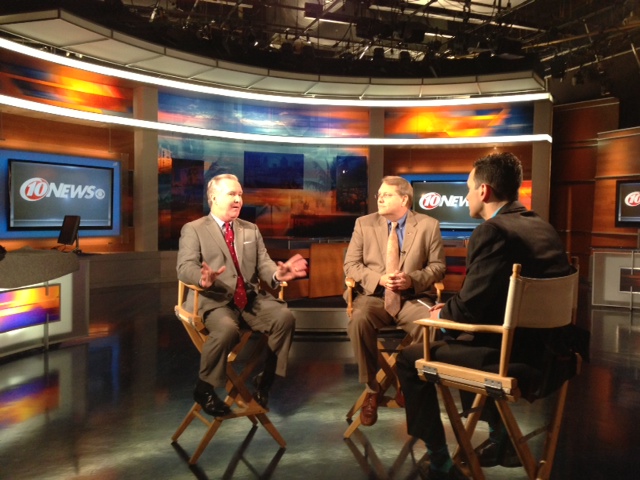
Foster has threatened legal action for any party that interferes with St. Pete's contract that runs through 2027; Buckhorn has made numerous public comments about the potential for a Downtown Tampa baseball stadium.

But when asked about the "obstructionist" labeled some have bestowed upon Foster, Buckhorn actually applauded his counterpart's handling of the situation.

"Bill Foster has a fiduciary responsibility to the citizens that he represents," Buckhorn said. "I get everything that he's doing and everything that he said. I don't begrudge him one iota. He's doing exactly what he was elected to do: protect the interests of the city of St. Petersburg.

"That being said, if they somehow come to an agreement with Rays of a buyout - of a severing of that relationship - that's where the rest of us, who are not involved in this contractual relationship, would have a role to play."

Buckhorn repeated that he won't interfere with St. Pete's contract with the Rays as long as the relationship exists.

Foster, meanwhile, addressed questions about his 2009 campaign platform of helping the Rays build a new stadium. He told 10 News on the campaign trail that the Rays would leave town if they didn't have a new stadium by the time the bonds were paid off on Tropicana Field in 2016.

"I think the economy, certainly, is hindering anyone's desire to publicly finance a new stadium," Foster said, explaining his hesitation to rush a new stadium project. "The city of Miami has killed (motivation) for the state of Florida when it comes to publicly-financed stadiums. And I think the idea of having to redevelop (the current Tropicana Field footprint of) 85 acres...we're not coming out of that recession yet."

Foster indicated redeveloping the current Tropicana Field site - part of the failed plan for a new waterfront stadium in 2008 - would not be easy. Earlier this week, Rays Vice President Michael Kalt told the Pinellas Board of County Commissioners that redeveloping the site was a big opportunity for taxpayers to recoup some of their Tropicana Field investment.

Foster says his door has been open to the Rays and hopes to catch up with principal owner Stu Sternberg in upcoming weeks. His recent efforts have been to discuss the possibilities of the Carillon stadium proposal. Multiple studies have indicated the number of residents living within 30-minutes of Carillon are similar to the number living within 30-minutes of Downtown Tampa.

"I just want to make sure St. Petersburg and Pinellas County are recognized as part of Tampa Bay," Foster said. "We're not competing with Tampa; those days are long gone."

Buckhorn agreed and said the mayors would continue to try and encourage the business community to buy more Rays tickets. The team has indicated a lack of business support - especially from Downtown St. Pete - has made a huge difference in their attendance numbers.

But neither Foster nor Buckhorn said they knew if a new Rays stadium was a "need" or a "want."  The team had the league's worst attendance numbers in 2012 but is believed to receive tens of millions of dollars in MLB revenue sharing.

"I would also like to hear how much the Rays are willing to commit as far as their resources for the construction of a new stadium 15 years premature; or 10 years premature," Foster said.

When asked about estimated contributions to - and revenues from - a new stadium, Sternberg told me he didn't know yet.

But with one of the league's best records in recent years and most disappointing performances at the gate, the Rays seem convinced Downtown St. Pete won't work much longer.

Mayor Buckhorn admitted problems exist with the stadium's location.

"There are reasons, whatever they may be, that fans have difficulty crossing 'the bridge,' " Buckhorn said, referencing the Howard Frankland Bridge that spans Tampa Bay. "Whether it's just historic, cultural, I don't know what it is. But the reality is, it exists.

"Could (a new stadium) work in Tampa? Possibly, possibly; but until something happens in St. Pete, it won't matter."

Buckhorn was asked if the Buccaneers - among the NFL's three worst-drawing teams for three straight years - were in danger of relocating if attendance didn't improve at Raymond James Stadium.

"I don't see them moving," Buckhorn said of the Bucs. "Part of it is they are locked into a long-term contract; they've proven they can succeed here; and the valuation of that team is probably eightfold since the Glazers bought the team."

"We really wrote the (Bucs') contract for the duration to make sure they were locked in," Buckhorn continued. "The public paid for that stadium; the entire stadium; lock, stock, & barrel."

When asked if a long-term contract and estimated franchise appreciation were enough to keep the Rays from leaving, Buckhorn said he wasn't privy to the team's contract with St. Petersburg.

But Foster said he was confident the team wasn't going anywhere.

Rays executives have pledged their commitment to the region, but indicated Major League Baseball has grown frustrated and could relocate or contract the team.

"Out legal staff spent a lot of time making sure," Foster said, "that - whether its an attendance clause, some perks that come back to the cities, or some things that we would forego - we make sure that the contracts are pretty solid."

Foster said he didn't anticipate any dramatic changes in the stadium rhetoric in the short-term, but welcomes discussions with Sternberg. In the meantime, he's counting on Rays attendance to pick up again.

"Andrew Friedman, Matt Silverman, and Joe Maddon," said Foster, mentioning the Rays' top executives and manager, "they are putting together an incredible product every single year."

"Coming out of this recession, you're going to see an uptick in ticket sales," Buckhorn agreed. "I think you're going to see an uptick in attendance, and hopefully - in the case of some of the teams - an uptick in performance on the field."

The Morning(s) After: Rays/Pinellas Fallout (Pt. 2)

This morning, the Tampa Tribune Editorial Board took a page from its competitor's playbook and criticized St. Pete Mayor Bill Foster over obstructing a Rays' stadium search.  Except the editorial's opening graf has one major flaw:
In the last week, Tampa Bay Rays owner Stuart Sternberg and his executives have proven to elected boards on both sides of the bay the franchise cannot survive at its current location and that St. Petersburg Mayor Bill Foster needs to allow it to scout the entire region for stadium sites.
What proof to elected boards?

The Rays presented selected attendance stats, but when asked for proper context for those stats, they refused.

The Rays have been asked about revenues and how much they'd put toward a new stadium and they refused.  The Rays haven't yet opened their books, as the Tampa Bay Times has repeatedly suggested, so how do we know drawing 19,000 fans a game is really a problem when the current MLB system is designed to help those teams compete, survive, and profit (as the Rays have)?

Oh, then there's this misdirection:
Ideally, a new stadium would be built in downtown Tampa. A few years ago a coalition of well-respected business leaders identified two locations in Tampa worth serious study: West Shore and downtown Tampa. Only about 616,000 people live within a 30-minute drive of the Trop, while the downtown Tampa "trade area" has about 1.6 million people within a 30-minute drive, making it much more centrally located.
The Tribune (for the second time this month!) conveniently forgets to mention that the ABC Coalition found St. Pete's Gateway/Carillon area would seemingly solve the team's "30-minute drive" problem just as well as Downtown Tampa would.  The two areas have extremely similar demographics.

Meanwhile, over in the pages of the Times today, a letter from Tampa resident Bill Bravick complimenting Bill Foster's financial stewardship.

Wednesday, January 30, 2013

MLS, Jags, Dolphins Line Up for State Money

A bill filed in the Florida Legislature by an Orlando-area Senator would make it easier for the metro to get the MLS team it's been trying to throw money at for years.

According to the News Service of Florda:
Up to two Major League Soccer franchises would be eligible for subsidies given to other pro sports teams in Florida under a bill filed in the Legislature, a nod to Orlando's bid to bring an MLS team to the area.

MLS has made it clear that it wants a franchise in the southeastern United States – particularly Florida. League Commissioner Don Garber said in November that Orlando is among the cities at the top of the list – if the question of a home stadium for a team could be worked out. A lower-division club, Orlando City, and its owner Phil Rawlins, are trying to elevate the club to the sport's top U.S. league.

A measure (SB 358) filed earlier this month by Sen. David Simmons, R-Maitland, would add MLS to the list of leagues in which franchises are eligible for a $166,667 monthly subsidy from the state. Currently, NBA, NFL, Major League Baseball and National Hockey League teams are eligible for the payments. Simmons' bill says two facility certifications for new MLS franchises should be reserved.

The help for a future Orlando soccer team comes in addition to a request by the Miami Dolphins NFL team for help with stadium renovations, and the speaker of the House said Wednesday that he expects other bills to be filed to provide help for renovations to an auto racing facility and for the Jacksonville Jaguars to make renovations at EverBank Field.

While the money in the Simmons bill isn't specifically tied to stadium construction, it could help the Orlando team's bid to join MLS. Team officials have said they want to build a soccer-specific stadium in central Florida to bolster the bid, and how that would be paid for isn't clear.

The Miami Dolphins have also said they plan to ask the Legislature to provide the team with a $3 million-a-year tax rebate on sales of merchandise to fund a renovation of the team's suburban Miami stadium. The team also wants lawmakers to let Miami-Dade County raise a tourist bed tax from 6 percent to 7 percent in some areas to help the team.

Speaker Will Weatherford said Wednesday that the House is expecting to hear from a few other sports facilities wanting money, and that Rep. Ritch Workman, R-Melbourne, the chairman of the House Finance and Tax Subcommittee will have a major role in evaluating the logic of providing such financial help when the economy is only just starting to sputter back to life.

"We hear rumors that there's also going to be a bill filed dealing with the Speedway, and them asking for us to partner with them to help with renovations, we hear there's going to be a bill filed dealing with the Jacksonville Jaguars stadium to help with renovations there," Weatherford said.

Stadium Talk Radio

For the very latest on the Stadium Saga, you can listen to me on Tampa's 98.7 The Fan tonight with Todd Wright at 8 p.m.

Then, Thursday morning at 10:20, with Orlando's Marc Daniels on 740 The Game.

Also, here's a link from this afternoon's hit with Whitney Johnson on Tampa's 1040 AM.

The Morning After: Rays/Pinellas Fallout

Some perspespective on yesterday's Rays meeting with Pinellas commissioners, in addition to my post pointing out the team's provided season ticket stats paint a very incomplete picture (and my subsequent clarifying tweet).


STU STERNBERG: A new stadium, in the right place, would average 30,000 fans a night.

The Rays' owner said a new stadium would bring the Rays up to the league average, but even a stadium dead smack-dab in the middle of Tampa Bay's business core, Westshore, would only increase the number of fans living within 30 minutes of the stadium to somewhere in the 1.6 million range.  That would still only rank the Rays approx. 24th in the league.

The Marlins' brand-new stadium drew just 28,400 a game in its first season.   The Mets, with their large payroll and even larger market size, drew just 28,305.  The playoff-bound Reds drew just 28,978 in their new stadium.  And the Braves, playing in a large market and a modern stadium, drew just 29,878 last year.

After the meeting, I asked Sternberg how he expected to draw 30,000 fans a night, to which he responded, "I believe in baseball."  I asked for clarification and he said he believes in the Tampa Bay fans to come out if a new stadium is built.


STU STERNBERG: "We’re not going to be able to continue (this kind of success), even with a $150M payroll...But (new revenues) help to stack the deck."

Sternberg said the team can't sustain its success without a new stadium, but yesterday, he said they couldn't sustain its success with a new stadium, either.  So how much better of a shot will the Rays have with the new revenues from a new building?

That would depend on how much the team would take in from new revenues.  How much new revenue would a stadium create for the Rays?  Sternberg told me after the meeting he hadn't looked into it yet.

It's a baffling response, considering Sternberg had just told the Pinellas Commission that "we like to plan out...based on future revenues...so when we sign Evan Longoria to a contract that's going to run past 2020, we've got to make decisions based on some of the facts we know."


TAMPA BAY PARTNERSHIP: We could facilitate discussions between the Rays, St. Pete, and others.

Courtesy of the Trib's Michael Sasso, news that the region's economic promoter (with Rays President Matt Silverman on its board of directors) may try to help broker a deal or at least break the ongoing stalemate.  In 2011, I speculated that business groups may help broker a deal between the Rays and St. Pete, and - sorry Pinellas Commissioners - it remains the most likely avenue toward finding some middle ground.


TIMES EDITORIAL BOARD: "The mayor sat in the audience...but slipped out midway through, leaving the commission chairman, Ken Welch, to pass along Foster's offer to meet with Sternberg on Thursday. It was an awkward move that captured the mayor's halting performance on a day when the focus was opening lines of communication."

As Mayor Bill Foster has pointed out, he and the Times have drastically different goals in the Stadium Saga.  So it's no surprise the paper took another jab at him.

But when the mayor had to leave 15 minutes early to meet with Sweetbay supermarket executives in Gainesville - a meeting the Times' editorial board suggested a week earlier - it's unfair to criticize his priorities.  Mayor Foster says he has been rebuffed by Sternberg at least twice recently in attempts to "open up lines of communication," as the Times implores.  And upon leaving yesterday's meeting, he sent the message that his door was still open to the Rays' brass.

Tuesday, January 29, 2013

Beyond the Numbers: Rays Season Ticket Stats

The Tampa Bay Rays revealed for the first time Tuesday that only 300 of their 81-game season-ticket accounts come from St. Petersburg, where Tropicana Field is located. The 300 full-season accounts total fewer than 1,000 season tickets.

But the selective stats, which do not include partial season-ticket packages, may not tell the whole story.

WTSP asked the Rays for more information on the season-ticket base, but was told the team didn't want to give out any more specifics.

However, in 2008, the Rays submitted data to the ABC Coalition indicating 47% of its season tickets came from Pinellas County. The team's Tuesday statistics included just the city of St. Petersburg, which makes up just 27% of Pinellas County's total population.

According to the 2011 statistics from the U.S. Census, St. Petersburg has a population of 244,997, while Pinellas County has a population of 917,398. Hillsborough County has a population of 1,267,775.

The Rays were making a point about lack of business support in St. Petersburg. The team said Downtown St. Pete was just the fourth-largest business core in Tampa Bay, trailing areas such as Carillon, Westshore, and Downtown Tampa.

In 2010, the ABC Coalition concluded the Rays' attendance problem was largely due to the fact that local businesses weren't buying season tickets, but there would be opportunity to improve if the team moved closer to the business districts in Tampa.

Not only did the stats the Rays provided on Tuesday omit partial-season ticket-holders; it also didn't include single-ticket statistics.

In 2008, the team told the ABC Coalition that 25.4% of single-game ticket-buyers came from Pinellas County while 25.0% came from Hillsborough County. Pasco County accounted for 8.6% of single-game ticket sales, Manatee County accounted for 6.8%, and all other counties and states accounted for 34% of single-game tickets.

The Rays told Hillsborough Commissioners last week of great growth potential across the bay, since 33% of their total fan base comes from Hillsborough County, compared to just 25% from Pinellas County.

Rays Meet With Pinellas Commissioners, St. Pete Council

Five days after the Tampa Bay Rays told Hillsborough County Commissioners that Major League Baseball has "lost faith" in the region, the team's top brass told Pinellas County Commissioners that a new stadium would restore the league's confidence.

The Rays, in their first face-to-face meeting with Pinellas commissioners in years, also encouraged them to help break the stadium stalemate with St. Petersburg, which has a contract with the Rays at Tropicana Field through 2027.

St. Petersburg Mayor Bill Foster and most of the city council attended the meeting as well, and heard the Rays disclose for the first time the scant number of St. Pete residents who buy season tickets.

Rays owner Stuart Sternberg told commissioners that fewer than 300 St. Pete residents have season-ticket accounts, accounting for just shy of 1,000 season tickets. Sternberg pointed out a lack of business support in St. Petersburg, Tampa Bay's fourth-biggest business center.

Sternberg mentioned North St. Pete's Carillon/Gateway region, Tampa's Westshore, and Tampa's downtown as more viable locations, indicating a new stadium in the right place could draw 30,000 fans a game.

Yet when asked by 10 News after the meeting why he wouldn't accept Mayor Bill Foster's invitation to discuss an advanced proposal at Carillon, Sternberg repeated his three-year-old mantra that he wouldn't consider any sites until he can consider all sites, including Hillsborough County sites.

10 News also questioned Sternberg about the likelihood of drawing 30,000 fans regularly when several playoff teams with new stadiums failed to draw 30,000 fans per game this year.

"I believe in baseball," Sternberg responded, before looking for the next question.

Rays Vice President Michael Kalt told commissioners that St. Petersburg could recoup much of its investment by tearing down Tropicana Field and redveloping the land once a new stadium is built.

"There is a huge opportunity cost (for prolonging the stalemate), Kalt said. "Keeping us handcuffed to the Trop, it's not doing anything for the taxpayers and people of St. Pete."

Sternberg tempered expectations that a new stadium might guarantee a winner, but said new revenues would help.

"We're not going to be able to continue (our success), even with a $150 million payroll," Sternberg said. "You can't guarantee this kind of success. But it helps to stack the deck."

Sternberg did not mention the spector of contraction, as he did last Thursday in Tampa. But he repeated how disappointed he was in the region's rejection of the 2008 stadium on St. Petersburg's waterfront.

Mayor Foster sent a message to Rays brass that his calendar was open this Thursday morning from 7 a.m. to noon and he'd invite Sternberg to meet with him again. When asked if he'd accept, Sternberg said, "Maybe, I'll have to check my calendar."

When asked how long he was in town, Sternberg remained coy, simply saying, "A few days."

For more on the day's development - and video - continue reading on WTSP.com.

Glazers' Man U Valued Over $3 Billion

After a few tough years (and "tough" is all relative when you're billionaires), the Glazers get even more good news from Forbes, which estimates Manchester United is the first sports franchise valued at over $3 billion ($3,300,000,000, to be exact).

After Real Madrid, the Yankees and Cowboys are tied at No. 3 overall ($1.85 billion), while the Glazer's other team, the Tampa Bay Buccaneers, held steady at $981 million, good enough for 29th in the world.

Malcolm Glazer was last ranked by Forbes as the 108th-richest person in the world, but you can expect that ranking to climb next fall.

Zimbalist on League Consultants, 2004:

Andrew Zimbalist, NewsHour with Jim Lehrer, 12/22/04:
Practically every stadium that's come on stream in the last 20 years in the United States has been accompanied by a consulting report - these are hired-out consulting companies - that are working for the promoters of the stadium. They engage in a very, very dubious methodology. They make unrealistic assumptions and they can produce whatever result they want to produce.
Hat-tip to Neil deMaus.

Monday, January 28, 2013

Important Disclosure on Zimbalist's Rays-to-Tampa Argument: He's Paid by MLB

Last week, the Tampa Bay Times posted a Q and A on the Rays Stadium Saga with leading sports economist Andrew Zimbalist.  I questioned a few of his statements, such as:
  • Downtown Tampa is the hub of regional business (Westshore has more office space);
  • St. Pete should offer the Rays a buy-out;
  • MLB could contract the Rays if no new stadium is built.
Then, after the Rays essentially echoed many of Zimbalist's sentiments on Thursday, I made a discovery:

Andrew Zimbalist is currently paid as an MLB consultant.

Zimbalist confirmed in an email he has worked off-and-on for the league over the years (including now).  He said he has also worked for the player's association, various teams, and numerous municipalities, but never directly for the Rays.

This isn't to question the validity of what Zimbalist was saying; merely to point out his realtionship with MLB.  It's an important disclosure that was omitted from the Times article; especially significant given the "MLB has lost faith in Tampa" statements made just days later.

Below is a statement provided by the Tampa Bay Times:
In response to a Times inquiry today, Smith College professor Andrew Zimbalist confirmed Monday that he is a consultant for Major League Baseball. He declined to discuss whether he is on a retainer or works on a project-by-project basis. One of his most recent projects was economic modeling to change baseball’s revenue sharing system. He said he has no current projects for Major League Baseball.
 
Zimbalist has written numerous books on baseball economics and has consulted on various sides of contentious baseball issues over the years. He helped the U.S. Justice Department draft a bill to partially lift baseball’s anti-trust exemption. He has represented the players’ union in contract negotiations with baseball, consulted for the city of Minneapolis in fighting baseball’s threat to eliminate the Minnesota Twins and helped Tampa’s Frank Morsani, a would-be owner, sue Major League Baseball.

The Times did not know of any ongoing relationship between Zimbalist and Major League Baseball when it published an interview with him on Jan. 21. If we had, we would have disclosed that to our readers. Zimbalist said nobody within baseball asked him to make the comments published in that article.

500 posts!

Nearly four years ago, I launched this blog to track developments in the Rays' stadium saga as well as other business-in-sports issues.

Now, 500 posts later, it's developed into an important watchdog for the Tampa Bay region as the Rays' campaign for a new stadium drags on into another season.  The purpose of this blog was never to advocate for - or against - a stadium; merely provide important perspective, as journalists and columnists routinely do for businesses seeking community support.

Post No. 501 promises to be a doozy, but until then, here are some of the top highlights from Shadow of the Stadium's first 500 posts:
Special thanks to top referrers Jonah Keri, Rays Index, and Saint Petersblog!

Otto: Why Build a New Stadium if MLB Doesn't Believe in Tampa Bay?

Tampa Tribune columnist Steve Otto, echoing what I said Friday about MLB losing faith in Tampa Bay, asks today why we're talking about a new stadium if the league doesn't believe at all in the region:
I mean before Hillsborough County makes a deal with Pinellas and we agree to spend a billion dollars for a state-of-the-art retractable roof stadium with 240-foot TV screens hanging in all directions so spectators won't actually have to watch the ball game; before we build a network of highways to the new stadium; before we construct a mass transit system that covers both counties and goes directly to the ball park; before we once again sell our souls, it would be nice to know they believe in us again.

Foster Fires Back at Tampa Bay Times

The Tampa Bay Times, which is no fan of St. Pete Mayor Bill Foster, published an editorial last week titled, "Foster's credibility problem."  This morning, the paper printed Foster's op-ed reply. 

He writes, on the Rays issue:

(T)he difference between the Times' opinion and mine is crystal clear. I have and will continue to put the St. Petersburg and Pinellas taxpayers, who have invested hundreds of millions of dollars, first. The Times and I do agree on one thing — the Rays should open their books for city review. Until then, it is clear that the entire Tampa Bay area must support the team in its current home if a future anywhere in the region is to be contemplated.


Sunday, January 27, 2013

The Morning(s) After: Rays/Hillsborough Fallout (Pt. 4)

Because one, two, three extra posts weren't enough to completely recap all of the developments coming from the Rays' Thursday visit to Hillsborough County, here is more perspective on things said this week:


STU STERNBERG: "Transit (is) the real difference-maker...it's a foregone conclusion wherever we end up (with a new stadium)...there will be a (transit) stop there."
I was actually surprised the Rays didn't make a bigger deal of their need for transit, but the team may have gotten an indication (perhaps from their private discussions w/commissioners) that now was not the time to touch upon another hot-button tax-dollar issue.

Nevertheless, the Rays' brass, most of whom came from the Northeast, know transit is the easiest way to get folks to a game from 20 miles away.  I always theorized a stadium/transit tax might work here, but we'll likely never know...the transit movement is way ahead of the stadium push right now.


PINELLAS COMMISSIONER SUSAN LATVALA: "All those years of trying to get a team here; I was cheering when they came, but it hasn't worked."
The Rays will meet with Pinellas Commissioners on Tuesday and we can expect a repeat performance from Thursday.

But how can Latvala say the Rays' situation hasn't worked?  The team has been one of the league's best for five years, TV ratings have skyrocketed, the value of the franchise has soared, and Forbes indicates Sternberg & co. have made huge profits.

Sure, the great success probably isn't sustainable forever, but just ask the Red Sox or Phillies or just about any other team in baseball - it's never sustainable.  The fact is, baseball HAS worked in Tampa Bay and the Rays are trying to strike fear in the heart of fans by repeating their attendance numbers...rather than open up their books and actually prove financial struggles.


TBO's JOE HENDERSON: "I wouldn't get too worked up...This isn't the first time baseball's belief system has been tested.  During many years of covering the pursuit of a baseball franchise here, I heard the same thing about the Chicago White Sox, Minnesota Twins, Seattle Mariners and even the San Francisco Giants.
     "The common thread was that each team needed a new owner or stadium, so those cities were told if things didn't get better right away, their team could move to St. Pete.  How did that work out?"
Henderson, who recently moved from the sports page to the metro page, is emerging as one of Tampa Bay's most rational voices on the Stadium Saga.   He's right our region should be familiar with the "stalking horse" game by now (I reported a similar history Thursday for WTSP).  Yet when politicians change a lot faster than league executives, there are sometimes short memories of how thinly-veiled threats of relocation can be.


MIAMI HERALD: How a $91 million loan on the Marlins ballpark will cost Miami-Dade $1.2 billion.
This may not be as bad as the headline sounds since financing a loan always costs more than the principal alone (just take a look at your monthly mortgage bill).  But even $400 million in Rays stadium bonds could cost a billion dollars by the time the loans are paid off.  This article should make elected officials and taxpayers alike scrutinize any long-term capital project.

The Morning(s) After: Rays/Hillsborough Fallout (Pt. 3)

More perspective on things said in - and following - the Rays' meeting with the Hillsborough Board of County Commissioners:


STU STERNBERG: We welcome tough questions because we want the information out there.
The Rays' principal owner told commissioners he wanted to show his hand, but there has been no indication the team will "open its books."  Sternberg also had no hard numbers for Commissioner Victor Crist when there was a question of whether the Rays had been sandbagging their marketing efforts in recent years.  However, with no advance notice, I'm not sure how realistic it is for the team's owner to know numbers off the top of his head.


STU STERNBERG: I intend to (fulfill our current contract, but) I'd be surprised if that were the case; but I intend to.
It was a confusing answer to Commissioner Ken Hagan's question about the team's current use agreement with St. Pete, set to run through 2027.  The best interpretation is that the Rays will stay at The Trop as long as they legally are required to, but they're counting on cooler heads to prevail and find a replacement before then.


MICHAEL KALT: "At the end of day, Major League Baseball is a retail business and you need to be in a location that people can get to easily."

I don't know how much the Rays have followed other Hillsborough County issues lately, but there has been a big stink about proposed subsidies to another retail giant, Bass Pro Shops.  Hillsborough Commissioner Mark Sharpe said, "Bass is old-school retail...If we were going to give incentives, I wish the money would go to high-tech jobs."  While there is a difference between Bass Pro and MLB, the Rays could hurt their cause by pointing out that they're a retail business.


NOBODY: It will take this amount of public dollars of public help to build a stadium.
The only mention during the commission meeting of how a stadium would be financed came from  Hagan, who said "there would never be another sweetheart deal" like the one that built Raymond James Stadium 100% on the public dime.  After the meeting, when I asked Sternberg how much it would take to get a stadium done, he said, "I don't know." I asked if they'd looked into how much they'd commit and he said no.

Even if you believe the Rays don't know what a new stadium would cost or how much they're willing to put into one, one thing is clear: they don't want Tampa Bay to focus on how much a new stadium would cost, just what it would cost to lose the team.